
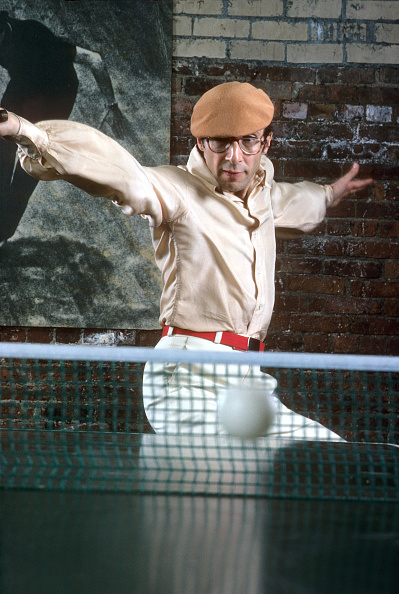
In his new Oscar-baiting film, Marty Supreme, Timothée Chalamet plays a ping pong prodigy who, much like the actor’s 2024 Oscar-nominated performance as young Bob Dylan, is a complete unknown. Well, unknown, that is, to anyone outside the famously insular table tennis community and even then, you’d have to be in your late 50s to be passingly familiar with the legend of Marty Reisman, whose life loosely inspired the movie. A high-stakes hustler, provocateur, bon vivant, and holder of 18 national and international table tennis titles, Reisman was the sport’s charismatic guru for more than half a century starting in the 1950’s. Three decades later, David Hirshey, then the editor of the New York Daily News Magazine, went deep into Reisman’s world and emerged with this award-winning profile of the man who may soon be known for winning Chalamet his (first) Oscar.—A.B.
The Fat Kid stepped off the bus triumphant. He was a little car-sick and his pants were too short and he had to squint up West End Ave. through thick black-rimmed glasses, but a smirk crossed his face as he watched the bloated yellow school bus rumble off.
“So long, suckers,” he said softly. He had humbled them all in Bunk 6 at Kezar Lake Camp, cut through the competition with such impudent ease that not even the redoubtable Herbie Schwartz had dared face him across the peeling Ping Pong table.
Now as he dragged his duffle bag up to 96th and Broadway, he could feel the thick red Butterfly paddle his father had given him for his Bar Mitzvah (“Now that you are a man, my son, you can use sponge instead of sandpaper”). He pulled it out and hit a few imaginary smashes. Then The Fat Kid drew in his breath and stepped down into the dark basement beneath an old movie house. Awe descended, along with a shower of paint chips from the ceiling.
The Riverside Table Tennis Club. Enter here and find a chump.
This was not the Y, not your genteel basement rec room where secretaries pushed demure volleys at each other during lunch hour. The Fat Kid knew this was the place the players came, a subterranean inferno where only the best could stand the heat. Reputations rose and fell with each scorching smash. Losers slunk up the stairs and disappeared from the neighborhood; winners left at dawn, their pockets crammed with cash. And the most hardened bettors suddenly were overcome in the middle of a gut-wrenching match. Some fell to their knees on the cracked linoleum floor, others had to be pulled, quaking, from bathroom stalls.
Marty Reisman. Transcendent guru of Pong. Showman, actor, raconteur, author, gourmand. Marty Reisman. Money player, high stakes con artist, backroom action guy.
The Fat Kid peered into the smoky room. Dangling 60-watt bulbs fought the gloom as little white spheres flew through the air at speeds The Fat Kid had never dreamed of. Tables dipped at precarious angles, propped by the stumps of broken paddles. People leaped, lunged, raced about, grunting in six languages. Korean masters dueled romance language professors; pinstriped stockbrokers pulled off their shirts and wiped their faces on monogrammed towels. In the corner, two gang members in leather jackets contested a point fiercely, a pile of chains and blades nestled in a sweatshirt beneath the table.
The Fat Kid sensed action. He craved it.
“Anybody want to lay three to two on a five spot?” yelled a skinny guy in a beret. He was holding a trash can lid. “I’m giving 18.”
A murmur swept the room; the plickety plock stopped.
“Eighteen is a helluva spot with a garbage can,” someone said. But nobody came forward.
“I’ll take that bet,” The Fat Kid heard himself saying. So what if the guy was three times his age, The Fat Kid thought. Hadn’t he brought all the counselors to their knees at Kezar Lake? Who was this joker with the garbage can anyway?
The Fat Kid served first. He cradled the ball in his palm, tossed it in the air and made a slashing motion with his paddle. The ball spun this way and that like a gyroscopic egg. He never did see the return, just heard the clunk of the garbage lid and the gasp of the gallery. 18-1. And so it went. 18-5, 18-11, 18-17, 18-21. Clunk. The Fat Kid slumped over the table, lighter by two weeks’ allowance.
“Who was that guy?” The Fat Kid muttered to no one in particular.
Sixteen years later, I found out.
Marty Reisman. Transcendent guru of Pong. Showman, actor, raconteur, author, gourmand. Marty Reisman. Money player, high stakes con artist, backroom action guy. Play him for $100? You bet. Need a handicap? Take 15 points. Not enough? He’ll play you with a shoe, a Coke bottle, his glasses, trash can lid. In the gospel according to Marty, you get them on the table at any cost. Toy with them, tease them with a couple of close ones. And then turn it on. A good hustler will kill you with confidence, with slow deliberate points, plucking wings off a fly.
“Putting the lock on,” says Reisman, “describes the state of the art.”
Like the time Marty put the lock on with the monkey. This is art: Reisman is at the table, in the middle of a big money match. In runs Betty the Monkey Lady. “Hey Marty,” she says, “I got to see the painter today. Can you take care of the monkey?” Betty’s living with an organ grinder and having an affair with the painter. Plunks the little ape on Reisman’s shoulder and takes off. He can’t quit so he decides to play with his right hand and hang on to the monkey with the other. More action. The monkey howls.
“I beat the guy easily,” says Reisman, “although my shoes got a little wet.”
Lest you think this is a circus, take a better look at the man. This is no glitzy hustler, no polyester cowboy who swats golf ball-sized truffles for some oil execs in a Houston hotel suite. Marty has credentials-17 national and international titles-and Marty has taste. Expensive taste: $100 custom shirts, 30-year-old wines and the kind of women who get a rash from anything less than silk.
“Marty,” says Reisman’s long-time exhibition partner Doug Cartland, “is the aristocrat of hustlers.”
The overall impression is long and loose. The delicate, long-fingered hands of a pianist dangle from bony wrists cuffed with silk. Billowing sleeves suggest balletic grace and indeed, when he lands after leaping to parry an impossible shot, there isn’t the slightest whisper from his custom suede sneakers. The ubiquitous beret never changes its angle; the man never breaks a sweat. His gaunt El Greco face looks as though it’s never seen a moment’s sun; the crease in his pants is as precise as his game. It has been 16 years since the Great Trash Can Hustle, but Reisman still has the same garden hose physique. Only the place looks different. Watching Marty shield his eyes like Dracula at dawn, I realize what it is.
Windows. The place has big picture windows, filtering sunlight into the room. You could no longer spend three days at Reisman’s and think six hours had passed. And all those fluorescent lights shimmering above $150 Harvard Professional Tables. How was a guy to turkey his opponent into playing uphill anymore? More alarming was the clientele, the fresh-faced, nicely clothed people. People with children and coordinated jogging outfits. People drinking apple juice and munching granola bars between games. Then I knew the place had really gone to seed. It was handling family trade.
“Disgusting, isn’t it?” asks Reisman. “The old place had a lot more panache.” The old place on the north side of 96th St. was torn down four years ago, but Marty simply packed up his blue and purple pimpled rubber Hock specials and headed across the street. Sent out the word that he was opening a new parlor.
“Within six months,” he says smugly, “I had effectively closed down the two competing joints in town.”
Since that fabled shootout, things at Reisman’s have settled into its owner’s natural pace. It opens soon after he rises at about 4 p.m., or whenever Reisman can pry an eye open long enough to toss someone the key. Early evening is slow. An elderly Chinese man curses softly in Mandarin at a malfunctioning black and white TV set while two Spanish kids overturn the coin-op soccer game to retrieve a ball. Someone punches the Coke machine. Nothing works well here but Marty, and he only gets rolling after 9 p.m. and a couple of stiff espressos.
Even then, his pace seems leisurely. That’s part of the con. Take that huge pile of fluorescent lighting fixtures sitting against a side wall. The old place had odd lots like that, too – a gross of somebody’s hot transistors, maybe 10 cartons of ballpoints. Judging by the dust, the lights have been here a long time, but like the best of hustlers, Reisman is a patient man. Some night, some sucker will come along who’s opening a doughnut joint. Marty will work up a little action and he’ll owe. But Marty will do him a favor, let him light up his doughnut joint with the whole lot for $500, cash. And hey, tellya what. Forget the C-note you just dropped on the table.
“Take a little, leave a little” is Reisman’s philosophy, developed soon after he had taken the governor of the Philippines for $3,500 back in 1952. During a break for dried monkey meat, it was strongly suggested that the skinny American leave the governor’s pride and well enough alone. Reisman promptly dropped a polite game and flew off to Taiwan and the next scam.
This and other tales are documented by the rogues’ gallery of photographs that hang on the brick walls at Reisman’s. They are all Marty Reisman, and he points to them often as if to verify his past. There is the serious table tennis champion in wire-rimmed glasses, posing with the trophy from the British Open; the cunning money player grinning like a mongoose from behind a banquet table with King Farouk; the steely-nerved smuggler posing innocently at a Buddhist temple in Hanoi; the grandiose exhibitionist leaping high above a table at Caesar’s Palace; the spellbinding raconteur holding Johnny Carson rapt. Reisman has carved a dozen lives for himself with a pimpled rubber racket and a rum runner’s wits. He has won and lost fortunes from here to Rangoon. Yet Reisman is still saving some picture hooks at the end of his wall.
“I’m just about to blossom,” he says, sensing yet another Reisman Renaissance. This is a phenomenon that occurs every few years. It happens when the media, bored by Hollywood hustlers and commercial dream merchants, sniffs around to find the real American hero. Inevitably they discover Marty. First, they exhume him from beneath a mound of yellowed clippings showing him playing footsie with the Maharajah somebody or other. Then they dust off a few bright and trite lines and voila – Mr. Original.
Last time it was China and Ping Pong diplomacy. This time, it’s Hollywood calling. Marty’s book, “The Money Player,” is about to become a movie; Public Television is planning a documentary on his life; he’s been asked to film a national beer commercial and play Vegas for a couple of thousand a pop.
“I’m a born again and again and again Jew,” he says. “At least five or six times in the last decade.”
Marty Reisman was born for the first time 49 years ago, just a double bounce from the Jewish Daily Forward down on East Broadway, son of a Russian emigre and a bookmaking cabbie who ran policy numbers and lost half his taxi fleet in a single poker game. Marty watched; he listened to the night sounds of crap games in stairwells and domestic arguments with the light of dawn. His mother left; Marty ricocheted between his parents and hotel rooms.
“Growing up with those insecurities,” says Reisman, “I had a nervous breakdown before I was 9. I was so insecure I felt I was going to die, was obsessed with the thought that my heart might stop at any minute. It reached its culmination one day at school. I felt my eyelid flutter…”
And he awoke in Bellevue.
“It was a horror house,” he says. “I wanted to get out so bad I learned to control myself in a month, then I outgrew this thing they called anxiety neurosis.”
Not coincidentally, he began to play table tennis. It began with an inexplicable attraction to those little white balls that bounced onto the sidewalk from the table on the roof of a neighborhood settlement house. Marty became obsessed with them; scooped them up and hoarded them in a dresser drawer. When his father’s girlfriend discovered the cache she bought him a Ping Pong paddle for his 11th birthday. Pimpled rubber.
The skinny kid practiced at the settlement house until at 13 he was City Junior Champion and an accomplished parks hustler, skimming a week’s beer money off players twice his age. At 14, the kid took his act uptown.
Lawrence’s Broadway Table Tennis Club, a former Legs Diamond speakeasy that still bore the bullet holes of late night raids, was the Runyonesque model for Reisman’s own parlor. It was in Lawrence’s that Marty got his degree in advanced hustling. The skinny kid became the Needle, and he could stick you bad. Reisman says it was the fear of going home busted that developed his kill shot, a devastating forehand smash clocked at 115 mph. The smash was his best offensive weapon, catching the ball low off the bounce and sending it back into an opponent’s solar plexus like a heat-seeking missile. Later, the London press would call it the Atomic Blast.
Like many of the top Pong junkies, Reisman took to smuggling and playing money matches to support his habit.
The Needle had a legit side, too. Or at least he tried. All was going well at the national championships in 1945. Reisman had made it to the quarterfinals of the junior division when the pressure of the competition momentarily addled his street smarts. He took his customary $500 bet and handed it to a man who surely looked like the bookie he’d dealt with all week.
“S’matter? Can’t handle the action?” Marty asked the red-faced man.
The president of the United States Table Tennis Association called the security guards who dumped the kid on the curb. Reisman was 15. A year later, Pong’s Bad Boy came back to win the national junior title and earn a place on the three-man U.S. team that sailed for England. Along with his rackets, Reisman disembarked carrying several dozen pairs of nylons.
Like many of the top Pong junkies, Reisman took to smuggling and playing money matches to support his habit. The week Marty won the British Open in 1949, he also did a brisk trade in crystal and ballpoint pens. At 19, he felt he could hustle the whole plickety-plocking world. So when the offer came for an exhibition tour with the Harlem Globetrotters, Reisman and his partner Cartland jumped at it.
Running with the Globetrotters, the pair worked a trail of hustles and hijinks across three continents and 65 countries: Living in cheap hotel rooms strung with socks and soup cans; beating the check at Maxim’s; mayhem in Munich, two wacko Americaners playing five balls at once before 75,000 in a Berlin soccer stadium. They played “Mary Had a Little Lamb” by hitting balls at frying pans; snacked on preserved locusts between matches in Manila. In Thailand, they played through an earthquake (“I thought it was applause,” says Reisman). Fifteen years older, Cartland was the straight man, a slow-talking Southerner who Reisman claims has the first nickel he ever made. Marty was the guy who tried to sneak into the harem; the incorrigible partyer with an itch for action and a near-fatal charm.
Those years were a high stakes hobo’s dream. Then without warning, Reisman’s life changed at the 1952 World Championships in Bombay. His nemesis: two round pieces of sponge rubber glued to the paddle of Japan’s demonic Hiriji Satoh.
“It was as if I were deprived of one of my senses,” Reisman says of their match. “You’re conditioned to react to the plickety plock and this sponge caused dead silence.”
And deadlier spins. Reisman’s Atomic Blast fizzled, impotent, off Satoh’s sponge and Marty was humiliated. The consummate hustler had become the bewildered hustle. For Reisman, the era of sponge descended like a silent shroud. He dedicated himself to revenge.
Smuggling and stroking their way to Tokyo, Reisman and Cartland worked to set up the Big Sting – a challenge match against Satoh and world doubles champion Nobi Hayashi. The backer: the Japanese promoter who was already marketing Reisman/Cartland dual signature Ping Pong balls. They bit. So did Japan; there were 50,000 requests for tickets and a live national radio hookup. “We were playing for the highest stakes,” says Reisman. “Pure ego.”
And Marty was ready. There would be no rash of smashes this time, no blind offensive barrage that would allow Satoh to turn his power against him. Goddamn sponge. You could kill a 115-mph forehand with every ounce of your bodily strength and some little guy would stand back there, hold out a little slab of foam rubber and the ball would rebound back in your face. So Marty would have to wait, to push, push, push, until he found the opening and then go for the throat. It worked. Unaccustomed to taking the offensive, Satoh slammed and slammed, spun and spun, a desperate man rendered helpless by an opponent armed only with a pimpled rubber and his indomitable hustler’s spirit. Sayonara, Hiriji. The final scores were 21-9, 6-21, and 21-15 and when it was over, the wildly cheering Japanese fans picked Reisman up on their shoulders and carried him around the theater.
When you’re rolling a string of sevens, you keep throwing. Reisman and Cartland kept moving, flung themselves at every comer from Adelaide to Bali, cadging flights on military hops to play at U.S. bases, those great roosts of G.I. pigeons fattened on PX Pong tables. And not all the suckers wore dog tags. There was lunch with Prince Sihanouk; an audience with Pope Pius XII, a command performance for Egypt’s King Farouk.
“You can’t name a maharajah that I haven’t played for,” says Reisman.
And outside the palace gates, a little side action. Watches and perfumes crossed borders with impunity on the customs-free military flights; $500 watches nestled safely in the toes of Reisman’s socks. For $1,000 a trip, he carried 20 pounds of gold bars from Hong Kong to Rangoon, strapped to his bony frame in a custom-made vest. At 27, Reisman was at peak form, Errol Flynn with pimpled rubber, carving up the world.
“My whole life has been flirting with danger,” Reisman says. “I’m not a guy to skirt through life hitting all the edges. I’m not into buffoonery like Bobby Riggs. There’s an aura of chintziness and stealing about the hustler. But the money player – he’s a gladiatorial hero, bare-chested to the enemy. It’s like going there in a hail of bullets. When I’m out there, the money is not as important as the excitement and drama. I’m a frustrated thespian. I need the attention, the recognition and applause. When you’re on before a crowd, the body and mind reach astonishing heights. You’re constantly working, tightening all your forces, all your craftsmanship. It rises to a peak where you’re eliminating all the imperfections in your game, a nirvana of concentration…”
Then sometimes, life intrudes. The light of dawn appears around the cracks of the door. For Marty Reisman, it was a woman.
She was beautiful and willful, the kind of dame who wouldn’t answer Bogart’s whistle. Yet she left a multimillionaire husband for an itinerant Ping Pong player. There was a marriage, and the pressure to provide. And there was a baby daughter.
“I was trying to make money in all directions,” says Reisman. “Gambling, hustling, playing. Bought the Riverside club and worked the joint 14 hours a day. No sleep, hardly eating. There were physical symptoms – blurred vision, forgetfulness. I was running myself into the ground.”
Comes a big money match in Las Vegas. It could set them up for a year, keep the kid in booties. Reisman walks out to the table and suddenly, again, that flutter of the eyelid.
“I felt a palpitation and it seemed an interminable time until I felt the next heartbeat. I screamed, ‘Help me, save me, I’m dying.’ I clawed my way through a mob to get out of the arena.”
And straight to a hospital. Once again, life had put the lock on Marty Reisman.
It was a year before he could pick up a paddle; soon after, his marriage was tabled for good. Serious national competition ended in 1960 when Reisman threw in the sponge he had used to defeat Bobby Gusikoff for the American title. Sponge had taken over, but it wasn’t for him. “I refuse to prostitute my skills,” he announces. “A sponge racket is like gravy covering up bad food.” And he hated the silence. It was as though the steady plickety plock of pimpled rubber echoed the heartbeat he was straining to hear, confirmation of his existence.
“I’m not bitter, I guess I’m just a romantic,” he says. “The players of yesteryear had a more romantic image. Maybe it was the primitive weapons, the pimpled rubber. It transmitted more of a struggle to the audience. Today, with a sponge, the player’s armed with a technological weapon. It’s like soldiers who meet with submachine guns instead of two guys from the Wild West popping shots at each other.”
So Reisman opted for the casual shootouts of the Wild West Side, ensconced himself below ground as a legendary star with orbiting weirdos – hustlers, physicists, pimps and sociologists drawn by that compelling gravitational pull: ACTION.
It is these Riverside habitues who populate his life now; the maharajahs are in their declining years; his family broken. Reisman’s daughter Deborah disappeared mysteriously two years ago at the age of 15, brainwashed, he believes, by religious cultists called the Oms. For nearly a year, Reisman worked with the police and the FBI trying to infiltrate the group which he believes is in the business of black marketing the babies its women produce. The last time Reisman saw Debbie, she could only hum.
“I think she’ll be back unless she’s dead,” he says. “It remains as the only real sore point in my life.”
Before he can get too morose, Marty begins pointing out the regulars in his place. He talks in caricatures rather than names: Freddie the Fence, Herbie the Nuclear Physicist, Betty the Monkey Lady, Louie the Commie, Tony the Arm. “I require constant intellectual stimulation,” Marty says. Having quit school at 15, he sops up random knowledge like a desk blotter.
The result: a dizzying collage of the trivial and the sublime. He can quote you today’s price on the London gold market, or a snippet of Proust. “It’s all part of my gestalt,” he explains.
“I’ve studied Marty for 20 years and he’s always been a likable meatball,” says Joe the 80-year-old archaeologist. “He likes to be around people who are authorities on all sorts of subjects. He’ll pose as an expert on the Middle East if he’s had a dish of couscous. Still, Marty’s a likable meatball.”
“Mahty.”
Leaning out to the steamed-up doorway of the Empire Szechuan Gourmet Restaurant on upper Broadway, a smiling Chinese woman draws Reisman and two visitors inside.
“Ah, Mahty.” His waist is encircled by the arms of a smiling young girl.
“Mahty.” Her sister is pulling out a chair, beckoning. Marty eats her often, frequently at 2 a.m. when the family has ushered out the last customer. Like a slender street cat, Marty slips in the door and takes his places at the table with the family, eating the “real Taiwanese stuff” that the chow mein trade won’t touch. These people, too, are part of the polyglot collection of sweethearts and strays that make up Reisman’s extended street family. Casually, they “do” for one another; a meal here, taxi fare there. And tonight, a Chinese cornucopia for the newspaper guy and his wife.
“Special for you only, Mahty,” the waitress says as she sets a perfect golden flounder before him.
“Was Marty famous for his Ping Pong in Taiwan?” I ask.
“Oh, yes. But much more for smuggling gold. Mahty was the best.”
Uptown, Friday night. 9:00. I spot Marty strolling along Broadway, cigarette dangling from his lips, head wagging like one of those rubber dogs you hang from a rear car window.
“Had a macrobiotic dinner tonight,” he croaks. “Need espresso quickly.” We duck into a Korean coffee shop.
“Espresso, straight, yes?” says the counterman, who knows.
“Make it a double,” says Reisman. He slaps at an empty pocket and instantly, one of the Koreans is at his elbow with a pack of Tareyton longs.
“Caffeine and nicotine,” sighs Reisman. “Now I’m ready.”
10:00. Back at Marty’s place, things are disappointingly dull. Some serious-looking law students; a few couples on a cheap date. Marty settles into a game of gin at $25 a hand. After nearly an hour, he is restless. He springs up, and strides over to the center table. Without a word, he holds up a Tareyton, a conductor commanding his orchestra’s attention. All the action stops at surrounding tables and he starts to play the gallery.
“Ever see me break a cigarette? A startingly audacious trick.”
Dead silence as he sets the cigarette on the table edge and walks to the other side. He bounces the ball, swings, misses the cigarette by a foot.
“I know what you’re thinking. I’m washed up. A failure.”
Two more failed attempts. A fourth and he is visibly annoyed.
“Ashes to ashes,” yells Joe the Archaeologist. “Dust to dust!”
Reisman smiles. “Three to two for five bucks?” he says softly. Dave the Writer bites. Reiman stares down the table, drops the balls, swings. The cigarette snaps cleanly in half.
11:30. Back to the gin table. “Let’s face it,” Reisman says. “When I don’t play, this place is Dullsville. What am I doing here every night?”
Herbie the Nuclear Physicist speaks up. “This Ping Pong parlor is just an externalization of your soul,” he tells Reisman. “Constant movement, constant turmoil. It’s a womb to you. You could have moved this dump to a hundred better sites but you elect to stay in this environment. You can’t leave because it’s you.”
Midnight. A disheveled, seedy-looking guy taps at the door and Marty gets up from his gin game to meet him. He reaches into his pocket, peels off a few bills and comes back.
“Who was that?”
“Just a guy who’s had a string of bad. Needed $26 for a room.”
2:15. Marty is engrossed in a friendly game of gin for $100 a hand with a gentleman from Yugoslavia who has a strange attachment to his briefcase, rubbing the clasp with one hand all the while he plays.
“Jewel thief,” someone whispers. “Hot rocks.”
The phone rings and Jerry the Semi-Retired Stockbroker picks up.
“It’s for you Marty. Your girlfriend.”
Still holding his gin hand, Marty walks to the phone.
“No, the place is dead. I’m just sitting around talking to a reporter for the Daily News. These guys ask a lotta questions.”
He hands Jerry an eight of clubs to discard, motions for him to pick up a queen of hearts.
“Cards? Nah. Figured I’d lay off after the last couple of nights. I know I promised you. Yes, I love you.”
Marty throws the queen and draws again.
“Listen, baby, could you hold for a second?” Marty cups his hand over the receiver and tosses his cards on the table.
“Gin,” he says softly.
2:30. Enter two muscular black men in three-piece suits and fedoras. Marty introduces them around and explains that they’re from Cameroon. The more sinister of the pair is a security man at the Red Apple Supermarket around the corner. A brown belt in karate, he is a sobering deterrent against shoplifting. However, he has found that 90% of the people he catches stealing steaks live in his building. Therefore, it is not wise to go home early. He waits at Marty’s until 4 most nights, or until all the shoplifters have passed out on the stairs. Marty calls him the King of Voodoo and asks him to break the ceiling with his head for Dave the Writer, here. He fails, explaining, “the leaves aren’t right.”
“Got to get some action going,” cries Marty, jumping to his feet. “This place is dead. What do you say, Dave?”
“I’d love to see you play a money match,” I reply, a match being best two out of three games. “I didn’t say I’d love to play you a money match.”
“C’mon. It’ll make a good story. What’s five bucks to a major cartel like The Daily News?”
“Five bucks?”
“Yeah, and I’ll spot you 17.”
“17 if you play with your glasses.”
“18 sitting in a chair.”
“19 standing up.” I demand.
“19! My God, that’s an *impossible* spot. Nobody gives a 19-point spot. I have to play a perfect game. No margin of error.” A sigh. “Okay, 19 points.”
In the gospel according to Marty it says the easiest people to con are con men. Which is nice because I am trying to con Marty. I am no rank amateur. For one glorious week in 1971, I was actually a ranked amateur. No. 99 in the Pennsylvania State tournament. Only a cad would mention that there were 100 contestants.
During the five-minute warmup, I am careful to grip the racket like a meat cleaver, an old Reisman trick that fools no one. I cleverly hit my backhands off the table so that Marty can detect the soft underbelly of my game.
“Like the way you hit through that backhand,” Marty says, flashing a private grin that suggests “Kid’s obviously got no forehand.”
Turning to address the gallery of 15 insomniacs, he asks, “Anybody want a piece of this action?”
“I’ll take the kid for five,” says Herbie the Nuclear Physicist. “Reisman hasn’t played in weeks, he’s out of shape. He’s got his shoes on and he couldn’t spot a monkey 19. Just relax, kid.”
I take his advice and it’s 19-12.
“Just keep it in play,” I tell myself. “Wait till he makes a mistake or has espresso withdrawal.” 19-13, 19-14. Marty is bored and starts a yawn.
“Ever tell you about the time I issued that blanket challenge in Chicago? Said at a press conference I’d play anyone sitting down and give them 17 points.”
Click. I’ve gotten lucky. A looping forehand nicks the edge and I have him 20-15. One to go.
“So anyway, the doorbell rings at noon and it’s some smartass from the Chicago Tribune. Wants to know if the challenge still goes. Here I am, in bed, champagne bottles strewn around the room, a head like a tom-tom. I tell him okay and order breakfast. I figure if I beat him, I get a couple paragraphs, but if I lose…”
A second blessed accident. I chop back a return of serve and it clips the net, hangs for an agonizing second and crawls over. Game, Dave the Writer.
“So I let this chump beat me,” Reisman continues. “And he wrote a half a page. Sometimes,” he says, peering over the net, “there’s greater victory in losing.” There’s that knowing smirk again and Marty says
“Ten dollars with an 18-point spot.”
Marty is all business now, driving a fusillade to my forehand, bam-bam-bam. I go down meekly, 21-19 and the match is now even.
“How about a rubber for $20.”
“I think I’ve had enough, Marty.”
“But we always play a rubber here.” It isn’t the statement that impresses me so much as the I’ll-eat-your-kneecaps-for-breakfast look on the King of Voodoo. I agree.
Marty is working the crowd now, cruising the table, talking about everything and nothing. His plan is to slam and slam, driving me far enough back so he can drop a shot and tell an anecdote before I get to it. After 10 points, my body is soaked in sweat. My hands bleed, and a blister has developed on my left foot. I am near collapse. Marty is dancing.
“Remember the trash can,” says an inner voice, and my resolve hardens. When Marty smashes, I race back six feet to return one, two, three slams. I keep giving him bizarre spins with my sponge until Marty pushes a backhand into the net. 19-15, mine.
“I know what you’re thinking,” says Marty. “You’re thinking I’m finished, washed up, over the hill. Can the aging champion recapture some of his former greatness and overcome yet another insurmountable obstacle? Ah, the drama.”
Marty runs off the next four points and Jerry the Semi-Retired Stockbroker is at my side with Band-Aids and paper towels. I feel like the Bayonne Bleeder getting ready to go back in against Ali. Marty is rolling. I serve and he whips off his glasses and returns the ball off the lens. He hits shots from behind his back, between his legs, nonchalantly flicks the ball back with the sole of his foot and shovels the ball at me with such heavy backspin that it hits on my side of the table and before I can get my racket on it, hops back across the net. 20-20.
“I have to admit,” says Marty, “I’m the most charismatic son of a bitch who ever stepped on a table.”
Now it is down to two points and I silently congratulate myself on having fought the good fight. But what I don’t realize is that Marty’s concentration is eroding. He hits a flat, high shot to my backhand. Whap. 21-20. On game point, Marty serves from a kneeling position five feet behind the table, I drop the ball just over the net and am halfway into my victory leap when Reisman scoops it back.
“Can you feel the tension in the air?” Marty asks before ripping a forehand drive deep in the left corner, I chop it back and the ball – can it be? – brushes the top of the net and falls dead. I have beaten Marty Reisman.
He peels off a crisp $20, and hands it over with a histrionic flourish. “For the Fresh Air Fund, I assume?”
“Yeah,” I tell him. “I’ll send a donation. And I’ll sign it The Fat Kid.”
[Photo Credit: Manny Milan]