
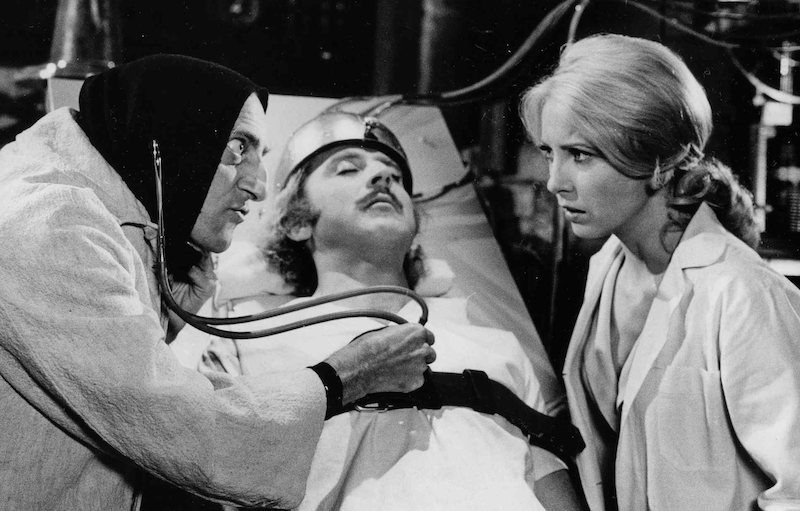
A prissy, old-fashioned maiden wakes from a swoon to see a corpse-colored giant with a large zipper in down at her prostrate form. Frankenstein’s monster! And, what’s even scarier, the monster is unzipping a zipper that is not in his neck.
“What do you think you’re doing?” the maiden demands indignantly. “Take me home this minute!”
The monster continues to unzip.
The maiden’s eyes widen. “Woof!” she growls.
Cut!” a hoarse male voice sings out from the back of the dubbing theater where Mel Brooks is supervising the mixing of sound with the edited film of his latest production—Young Frankenstein. As the screen goes blank, director Brooks strides forward. At 48, he is short, bull-chested, twinkly-eyed, with a nose like a dill pickle and a grin as wide as a two-car garage.
“Fellas, the zipper sound is much too short. This monster is seven feet tall. If we’re going for a dirty sound effect, let’s really go. Double the length of the zipper sound and raise it five db’s.”
As he trots down the hall to a recording studio, Brooks clutches his companion’s upper arm and yelps:
“Last day! In two hours, Young Frankenstein will be finished! And it’s my best picture! Better than Blazing Saddles! Better than The Producers! Better even than the Bic Banana commercial!” He rushes into the studio, where for the next 10 minutes he grunts, groans, sighs, sobs and smacks his lips into a microphone. “Born ham!” he brays. “Love it!” But when the session ends he turns to the man in the control booth and, smiling wryly, shakes his head “How about that. A grown man making silly noises while Jews are running through the streets of Baghdad with their hair on fire!”
In a world full of burning hair and other horrors, silly noises are not without value. The burdens of the Depression era ’30s were much lightened by some brilliant screen comedies, and as the economy of the ’70s sinks deeper into stagflation many customers once more seem to be shopping for belly laughs.
Brooks himself helped to launch the current comedy boom with Blazing Saddles, a raucous tour de farce that has run for nine months so far and that 20fh Century-Fox estimates will ultimately net about $25 million worldwide. Young Frankenstein, due for pre-Christmas release, may give the boom even greater momentum. Both subtler than Saddles and more richly absurd, it should appeal to a wider audience. Said a critic who saw the picture in rough cut: “It’s the funniest movie since A Night at the Opera. We may have a new Chaplin on our bands.”
Indeed, by now Brooks is almost as skillful as the little fellow in the derby at arranging a joke for the camera. Like Chaplin, Brooks is a self-taught intellectual with a tragic sense of life, a flair for the surreal and an obsession with the brotherhood of man—mainly observed in the lack of it. The Producers, for instance, along with all the fun, was a cautionary tale about the Bitch Goddess, Success; The Twelve Chairs explained wryly how a little touch of avarice makes the whole world one hell of a place to live; Blazing Saddles, examining the American proposition that all men are created equal, wondered: equal to what? As for Young Frankenstein, it’s about a somewhat mad scientist who tries to play God—and is made sane when he discovers God is love.
All these comedies shimmer with energy, rage and zest. Brooks at his worst is a boor of genius. At his best he is an absolute master of the maniacal.
“Madeline Kahn!” As Brooks arrives in the garden of a well-known Hollywood beanery, he awards a fatherly kiss to the actress who plays the monster’s virginal victim in Young Frankenstein. “Mmm! Softest lips since Horace Heidt! By the way, I just watched you being raped. Cute.”
Gene Wilder, star of Young Frankenstein (he was also a principal in two of Brooks’s three earlier features), arrives with Teri Garr, Marty Feldman and Kenny Mars, members of the cast.
“Marty,” Brooks announces when sandwiches have been ordered “is past Jew. He’s into surreal Jew.”
Marty, rolling his eyes in opposite directions: “My cologne is essence de Juif.”
Brooks: “So that’s what smells like chicken fat.”
The sandwiches arrive. One of the hamburgers has fruit on the side.
“Fruit?” Brooks asks Wilder.
“How did you guess?”
“The marcelled forearms.”
Feldman refuses a hamburger. “I’m a vegetarian. Offering me meat is like offering a man to Jack the Ripper.”
A truck thunders past, rattling the silverware.
“Hi, King!” says Brooks. “It’s King Kong, folks. Coming for lunch. Lovely guy. Gray hair now. Carries this little old lady around in his hand.”
Inside Brooks the maniac is an artist of acute sensibility; inside the artist is a sober, solid peasant. Peasant energies fuel his imagination and peasant shrewdness regulates it. “Mel throws his head in the air a hundred times a day,” says a friend, “but it always lands on his neck.” His head contains a powerful Talmudic intelligence that, in his life as in his humor, probes reality like a nut pick and extracts its meat. He is an exact judge of character and can rarely be beaten in a deal. In lifestyle he is conservative and rigidly moral. With family, friends and colleagues, he is loyal, warm and incredibly generous. “Good things happen to people who know Mel,” says one of his producers. But living dangerously in a dangerous business has made Brooks chronically anxious, and he relieves his anxiety by taking charge of every situation he finds himself in. “He’s a typical Jewish mother,” says a friend. “He orders your lunch for you, tells you what kind of car you shout buy, suggests good doctors and nice operations you could have.”
Anxiety has been Brooks’s lifelong companion. Born poor in Brooklyn, he lost his father (to a tubercular infection) when he was 2. Always a runt, Mel was bullied by other kids—until he discovered that wit could be an effective weapon. As a boy he sharpened his wit in street-corner repartee and in his teens perfected the weapon as a tummler in the Catskills resorts. He also read his eyes raw, storing up an immense if disorderly body of knowledge. Brooks set out to make a living with little but his talent to sell. At 26 he was earning $2,500 a show as a writer for Sid Caesar and Your Show of Shows.
Success almost destroyed Brooks. “In Brooklyn I never heard of anybody making more than $50 a week. How could I be worth thousands? Every minute I was waiting for a tap on my shoulder. ‘Out, kid. You’re fired.’ The anxiety got so terrible I began to vomit in the street.” Psychoanalysis helped, but just as Brooks was beginning to feel secure in his success, comedy shows went out of style. Brooks’s weekly salary skidded from four figures to two, but alimony from his first marriage to dancer Florence Baum and the support payments for their three children stayed where the judge had pegged them.
Brooks’s fortunes took an upward turn with a comedy record, The 2,000-Year-Old Man. Occasional TV writing jobs culminated in the spy-spoofing series Get Smart! that he helped create and wrote. A serious romance with a gifted young actress named Anne Bancroft led to marriage in 1964. They are making their first professional appearance together this week, in the ABC-TV special Annie and the Hoods. Except to say that he is deeply in love with his wife and almost as deeply in love with his mother-in-law’s cooking, Brooks declines to discuss his marriage. “It’s our business,” he says.
Brooks and three young writers are excitedly ‘pitching’ scenes for a new TV comedy series about Robin Hood, to be called When Things Were Rotten. Brooks is on tippy-toe behind the big curved, paper-littered desk in his office at 20th Century-Fox. Norman Steinberg is perched on a windowsill. Norman Stiles is standing on a coffee table. Jon Boni is pacing furiously.
Brooks: “Silly is what we’re after. Nothing too sharp. Horsing around. When the Sherrif of Nottingham’s tax collector tells the peasants to holder their tongues, they literally stick out their tongues and grab them with their own hands.”
Bondi: “But one peasant refuses to hold his tongue. The tax collector says, ‘Put him in his place!’ ”
Brooks: “So they do. Four henchmen pound him over the head with sledgehammers and drive him into the ground until only his head is showing. ‘He’s in his place, sir!’ ”
Boni: “What about Prince John?”
Brooks: “Big swish. Giggles. Wears earrings. Love to gavotte…The sheriff is the heavy. When he visits his dungeons the prisoners are moaning and weeping. Music to the sheriff’s ears. ‘I must come down here more often. It’s the only place I can really unwind.’ ”
Steinberg: “In one cell, this pale wretch is catching a pathetic sliver of sunlight on a sheet of aluminum foil he’s holding under his chin.”
Boni: “Let’s have a prisoner on a rack.”
Brooks: “Wonderful! He’s stretched out so far he goes all the way around the wheel and meets himself.”
Stiles: “The sheriff says, ‘Roll ’em!’ ”
Brooks: “The prisoner screams and the sheriff says, ‘Hm. I see our friend has just taken a turn for the worst.’ Oh, we’re going to have fun with the sheriff.”
“I’m not really a director, you know.” Driving home along Sunset Boulevard in a pale green Buick Riviera with a dented fender, Brooks is generalizing about the picture he has just finished. “I’m a writer. I direct to protect my ideas, to keep somebody else from messing them up. Most directors try to be funny when they do comedy. Disaster! The writer has to be funny, not the director, not the actor. When I did the Sid Caesar show the designer would sometimes try to do a funny set. All the writers would rush into his office, throw him down on the floor and sit on him. ‘Don’t help us!’ We would yell at him. ‘Make the sets real. We’ll do the jokes.’
“Comedy is about reality. The more terrible the reality, the bigger the laugh. In tragedy the writers weeps at the monstrous things that happen to people. In comedy he laughs. But crying and laughing are very much alike. You happen to look at somebody from behind whose head is bobbing up and down and whose shoulders are shaking. He turns around, and he may be either laughing or crying.
“In the last analysis, comedy is about death. Tragedy accepts death and tries to rise above it. Comedy tries to con death out of doing his job. Most people are afraid of death. I hate the son-of-a-bitch. I’ll tell you my ambition. Someday I’ll make death laugh so hard that he’ll drop dead!’ ”